
Blog
What Caregiver Burnout Really Looks Like Inside Indian Families

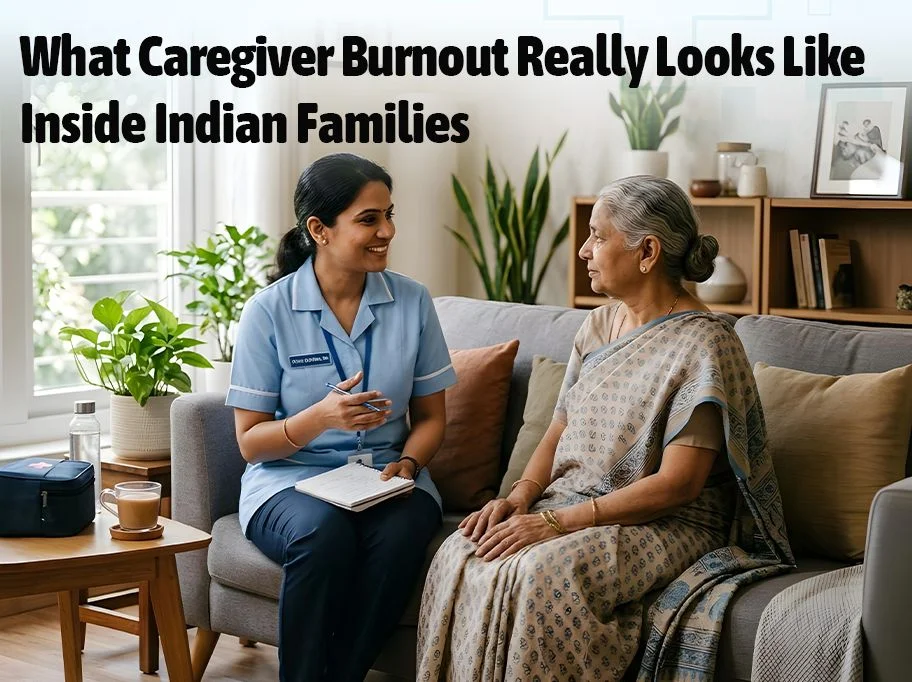
How missed sleep, deferred careers and quiet resentment reshape love and duty
What caregiver burnout really looks like inside Indian families is slow, quiet and almost invisible until the family is already stretched to its limits. It rarely starts with a crisis; it builds through missed sleep, deferred careers and unspoken resentment.
What burnout looks like in “normal” homes
In most Indian households, especially in cities like Gurgaon and NCR, caring for ageing parents is framed as love and duty, not as demanding work that needs structure and support. Families say “we will manage at home” and, for a while, they do.
Life appears normal from the outside. Parents are at home, children are working, festivals are celebrated. Underneath, one person is waking up at night, juggling hospital visits, tracking medicines and adjusting their job and personal life around an elder’s needs. Burnout enters long before anyone names it.
How it slowly begins
Burnout begins with small adjustments that feel temporary. A daughter starts getting up twice a night to help her father. A son moves back to Gurgaon “for a few months” after a parent’s diagnosis. A daughter in law quietly becomes the one who manages every doctor, report and attendant because she is “more organised.”
Sleep gets lighter. Weekends disappear into errands and caregiving. Social plans are cancelled with a tired “next time.” Work is done from hospital lobbies and waiting rooms. There is no single turning point, just an ongoing erosion of rest, time and autonomy.
The hidden costs: careers and self
Over time, the deepest impact shows up in careers and self identity. People turn down promotions that need travel, hesitate to change jobs, or step away from full time work because there is no backup for care at home. What begins as a short pause stretches into years.
Outwardly, these decisions are praised as sacrifice. Inwardly, caregivers often feel grief for stalled ambitions and worry about their own financial future. They stop thinking of themselves only as professionals and start seeing themselves primarily as “the one who looks after Papa or Mummy.” Love remains, but bitterness seeps in when their own life feels permanently on hold.
How burnout feels from the inside
Caregiver burnout is not ordinary tiredness. It is a state where a person lives on constant alert. Even when they are away from home, their mind is half listening for a phone call. Sleep is shallow because they are always preparing for the next emergency.
They may become irritable, snapping at parents, spouses or children and then drowning in guilt. Joyful activities feel like obligations. Concentration slips. The world shrinks to medicines, meals and appointments. There is little room for friendships, hobbies or even basic rest. The caregiver may begin to believe that their own needs simply do not count.
How it reshapes family dynamics
Burnout changes the emotional tone of the whole home. Siblings argue about who is doing enough and who is “too busy.” One sibling may provide day to day care while another sends money from another city, and both feel misunderstood. Spouses feel sidelined. Children sense tension and learn not to “disturb” the caregiving parent.
Elders notice this too. Some feel guilty and apologetic. Others become more fearful and demanding. Everyone thinks they are doing their best, yet love is operating under constant strain. Because no one wants to sound ungrateful, the family rarely admits how hard it has become until a health or emotional crisis forces change.
Moving toward healthier support
Healthier caregiving begins with an honest, shared view that one person cannot do everything indefinitely. Caregiving needs the same planning as any serious family responsibility: clear roles, budgets, schedules and backup.
It also needs outside support. Trained attendants, nurses, day care, respite care and, when the time is right, thoughtfully planned senior living can turn caregiving from a crisis pattern into a sustainable one. For urban families, especially in and around Gurgaon, this is where upcoming senior citizen projects in Gurgaon start to become part of the conversation, not as abandonment but as an extension of family care.
Senior living communities offer senior-friendly homes in Gurgaon, on-site assistance, engagement and proximity to hospitals, so that elders are safe and supported even when children cannot be physically present all the time. This allows adult children to shift from exhausted full time caregivers to emotionally present, decision making partners in their parents’ lives.
J Estates and a more sustainable future for care
Caregiver burnout in Indian families is not a lack of love. It is a sign that our old models of care are under pressure from longer lifespans, complex health needs and demanding city lives. The way forward is to maintain our values while updating where and how care is delivered.
At J Estates, we are shaping senior citizen housing in Gurgaon and Sohna that responds to this reality. Our senior living residences are envisioned as premium retirement homes in NCR that combine independent senior living apartments with the option of assisted living, wellness focused spaces and close access to quality healthcare. The aim is simple: elders live with dignity, safety and connection, while families are relieved from the most exhausting aspects of daily caregiving so love can breathe again.